



A New Asphalt Shingle Roof Before You Sell: What Bay Area Owners Should Know
Home Improvement Payback Guide, part 12 of 21
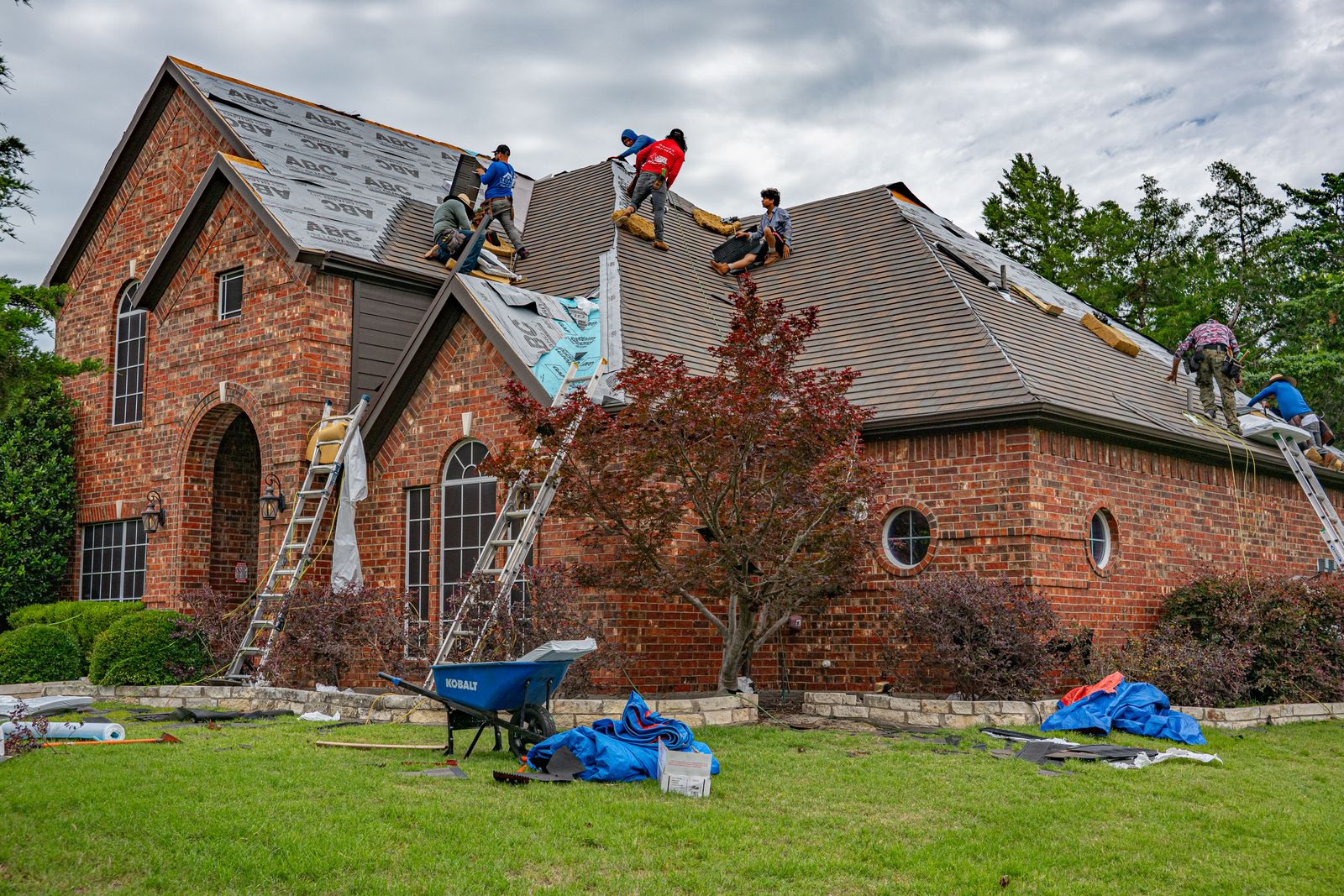
Illustrative photo, not a Bay Area property. Photo from Pexels.
Your roof does its job quietly until the year it does not. Maybe your insurance company just asked how old it is. Maybe you are thinking about selling and wondering whether a tired roof will scare buyers away, or whether a new one will pay you back. It is one of the biggest checks a homeowner writes, so the question deserves a straight answer.
Here is the short version. In the 2021 national Cost vs. Value study, a new asphalt shingle roof returned about 61 cents back for every dollar spent, ranking number 12 on its list. That is middle of the pack for payback, but a new roof does something the rankings miss. It keeps insurers calm and buyers confident, and that matters a lot around here.
Prefer to watch? I walk through it on video in under seven minutes, including the same house sold twice, once with the roof question open and once with it answered.

The job cost
$28,256
Back at resale
$17,147
The gap you absorb
$11,109
Cents back per dollar
61 cents
Numbers above are 2021 national averages from the Cost vs. Value study. They are a ranking guide, not a quote for your home.
What you spend, and what comes back at resale
The study priced a full roof replacement, not a patch
Before you weigh the numbers, know exactly what they price. The study did not price a repair or a few new shingles over a leak. It priced replacing all 30 squares of roofing, which is 3,000 square feet, with architectural style asphalt shingles. Architectural shingles are the thicker, layered kind that give a roof more texture and a longer life than the flat basic kind.
- New architectural asphalt shingles across the entire roof
- A ridge vent, which is a vent along the peak of the roof that lets hot attic air escape
- All the underlayments and accessories, meaning the water resistant layers and trim pieces that go under and around the shingles
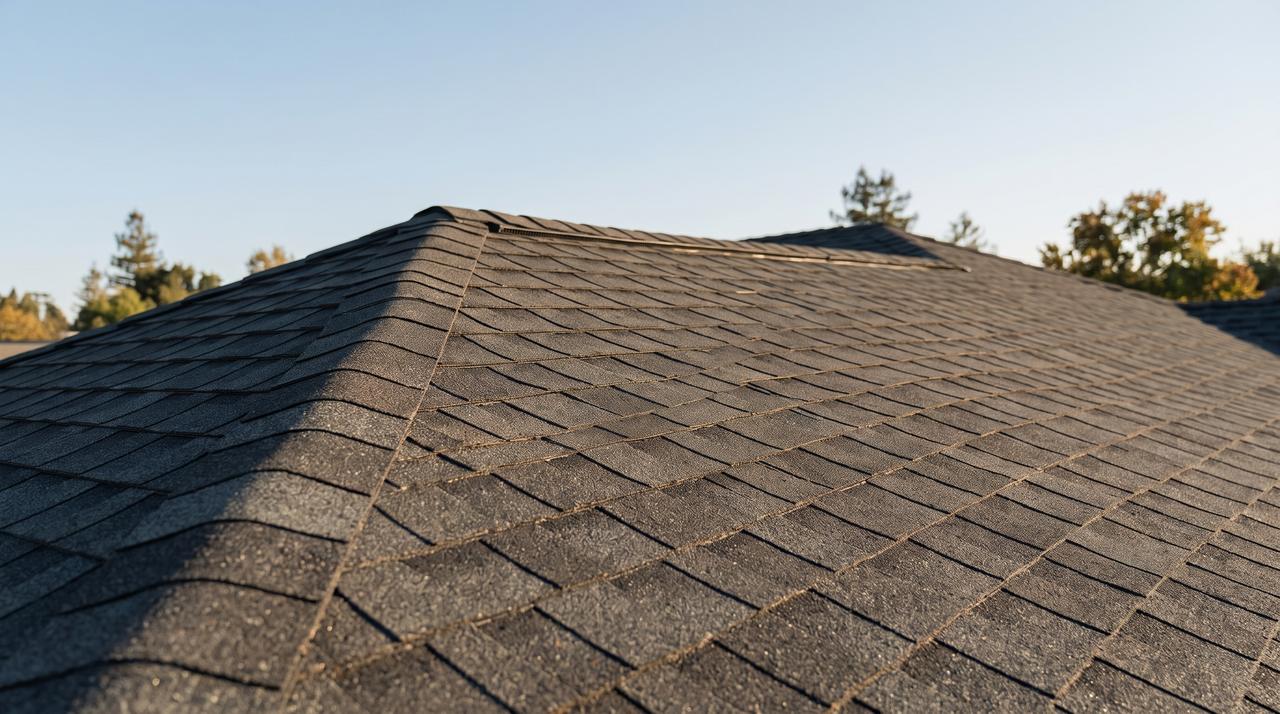
AI illustration from my video: new laminated shingles on a hip roof. The studied job lays them over new underlayment and finishes with a custom cap at a vented ridge. The picture was generated with Google Gemini and does not show a real home or project.
The 2021 numbers show a real but partial payback
The 2021 national Cost vs. Value study, the same study a popular real estate training course was built on, put the average cost of this roof job at $28,256. That is a national average, and Bay Area quotes usually run higher. At resale, the study found sellers recovered about $17,147 on average, leaving a gap of $11,109. In plain terms, that is about 61 cents back for every dollar you spend.
The same 2021 national data also lets you compare asphalt with metal head to head. Asphalt cost far less, $28,256 against $46,031 for metal, and it returned a higher share of its cost, 60.7 percent against 56.1 percent. The cheaper option won on both counts. Those figures are national too, so expect Bay Area bids for either roof to come in higher.
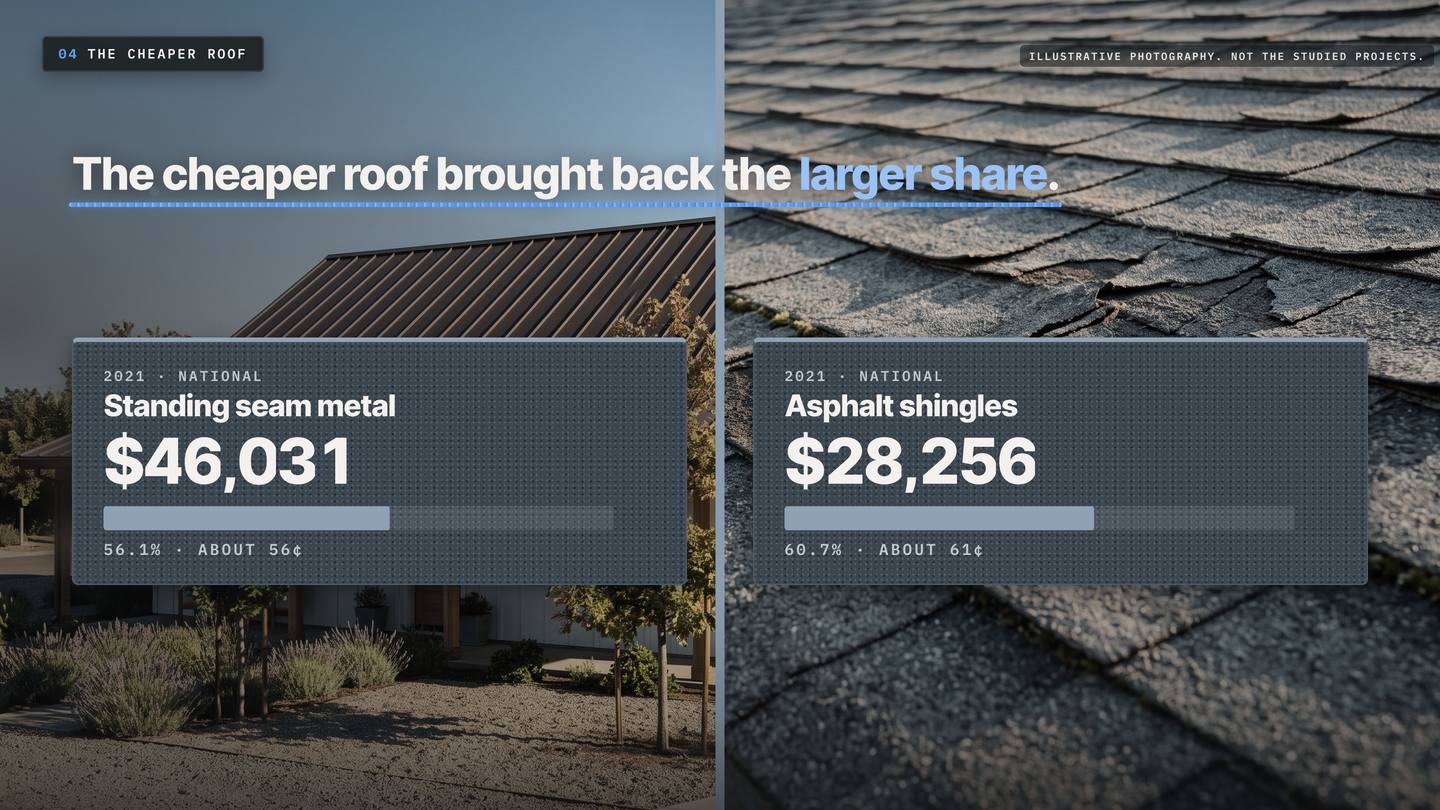
A frame from my video, 2021 national averages: standing seam metal at 46,031 dollars came back at about 56 cents on the dollar, asphalt shingles at 28,256 dollars at about 61 cents. The scene is an AI illustration generated with Google Gemini and the card is drawn in code. Neither shows a real home or project.
Today's San Francisco metro numbers look even stronger
The 2025 Cost vs. Value report for the San Francisco metro area prices the same shingle job at $38,289, with about $27,747 coming back at resale. Fremont, Newark and Union City all sit inside that metro. That works out to roughly 72 cents back for every dollar spent, twelfth of the twenty projects in this guide on the local list. One caution in plain words: the report changed how it collects and measures its numbers between 2021 and 2025. That means you cannot line the 2025 figures up against the 2021 figures and treat the difference as a trend.
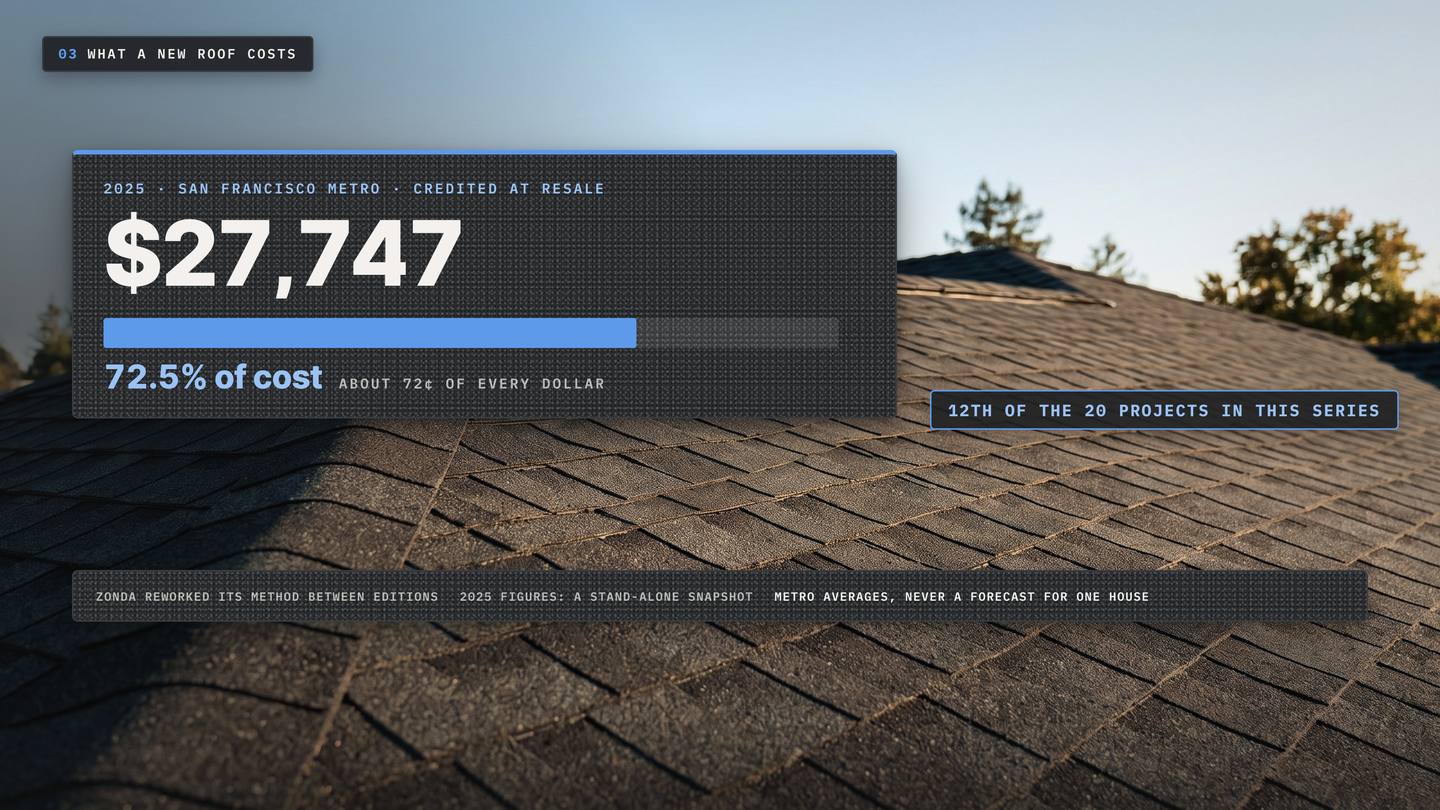
A frame from my video, 2025 San Francisco metro averages: 27,747 dollars credited at resale, 72.5 percent of the cost, twelfth of the twenty projects in this series. Metro averages, never a forecast for one house. The scene is an AI illustration generated with Google Gemini and the card is drawn in code. Neither shows a real home or project.
Around here, your roof is an insurance question first
In the Bay Area, a roof is an insurance question before it is a looks question. Insurance companies look hard at the age of a roof, and the rules vary by company. An older roof can limit what a policy pays, or end the conversation altogether. That means an aging roof can complicate your sale even if it has never leaked once, because your buyer may struggle to find an affordable policy. This strengthens the case for replacement well beyond what the resale percentage alone shows.
California just moved on this too. SB 1301, signed September 27, 2026, says that starting January 1, 2028, an insurer cannot refuse to issue or renew a policy solely because of the roof's age if the policyholder pays for an independent inspection confirming at least five years of useful life left. It is not in force yet, and insurers can still weigh the roof's age, but a roof report in writing is worth having either way.
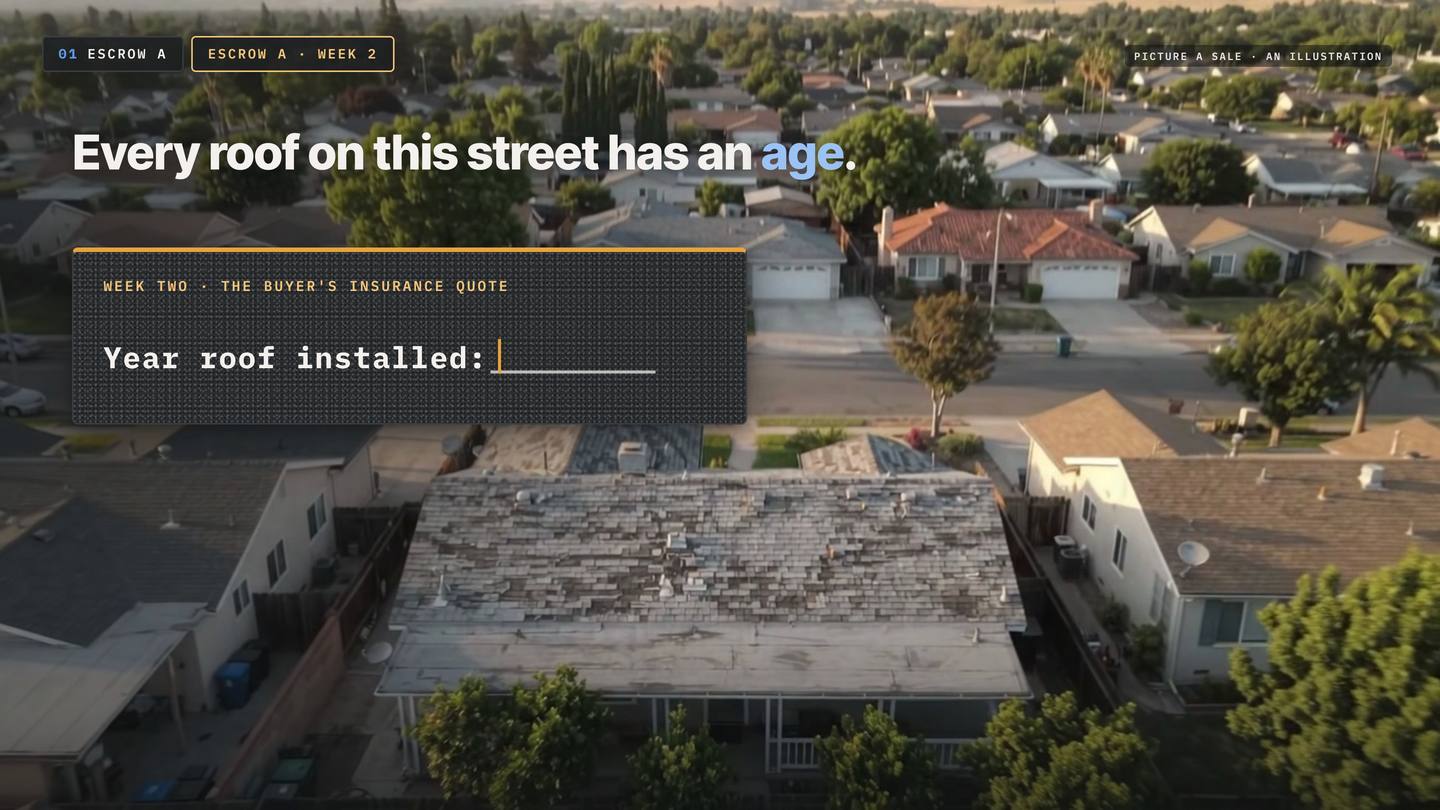
A frame from my video, an illustration and not a real street: the buyer's insurance quote wants to know what year the roof went on, and every roof on the street has an age. The street is a still from a clip generated with Google Veo and the card is drawn in code. Neither shows a real home or project.
One more thing to plan for. If your home was built before 1978, any work that disturbs painted surfaces triggers the EPA's lead safe work rules. Those are the federal rules that require certified contractors to contain and clean up dust from old paint that may hold lead. Ask your roofer how they handle this before the work begins.
Replace a tired roof before you sell, not after
A roof lives on the outside of your home, and exterior projects tend to earn their keep when you sell soon. Buyers judge the roof from the curb, inspectors flag it in every report, and insurers ask about it before they quote a policy. If you plan to list within the next year or two, take a hard look at a roof that is near the end of its life. Replacing it removes one of the biggest reasons a deal slows down or a buyer asks for money back.
Plan your timing, though. Good roofing crews book up fast, especially in the dry months when everyone wants the work done, so start collecting bids early. And here is the honest flip side: if your roof is in solid shape, your insurer is happy, and you are not moving anytime soon, skip it. A study average is not a promise, and replacing a roof that still works returns only part of what you spend.
Questions homeowners ask
How much does a new asphalt shingle roof cost in the Bay Area?
The 2025 Cost vs. Value report for the San Francisco metro area put the average job at $38,289 for a full shingle replacement. Fremont, Newark and Union City sit inside that metro. The report found about $27,747 coming back at resale, or roughly 72 cents back per dollar spent. Keep in mind the report changed how it measures between 2021 and 2025, so its numbers cannot be compared with older editions. Your own quotes will depend on your roof's size, pitch, and condition, so gather more than one bid.
Does a new roof help sell a house?
It helps the sale go smoothly more than it raises the price. In the 2021 national Cost vs. Value study, sellers recovered about $17,147 of a $28,256 roof job on average, which is about 61 cents back per dollar. Bay Area quotes usually run higher than that national cost. The bigger win is that buyers and inspectors stop worrying, and insurers are more willing to cover the home. These are study averages, not a promise for any one house.
Can an old roof stop me from selling my home?
It can slow you down in a way that surprises many sellers. Insurance companies look hard at roof age, and an older roof can limit what a policy pays or end the conversation altogether. A buyer who cannot get an affordable policy may walk away or ask for a credit. If your roof is near the end of its life, build that reality into your plan before you list. A quick conversation with your agent and your insurer will tell you where you stand.
More from this guide
- Every guide in one place: the Home Improvements page
- Start here: all twenty projects, ranked
- Part 11: A Fiberglass Grand Entrance Looks Impressive. Does It Pay You Back?
- Part 13: What a Midrange Bathroom Remodel Really Returns When You Sell
- Part 4: Fiber Cement Siding in the Bay Area: What It Costs and What Comes Back
- Part 5: Do Vinyl Replacement Windows Pay You Back When You Sell?
See the full charts and payback calculator →
Thinking about selling in the next year or two?
The remodel conversation belongs 6 to 12 months before you list, while every option is still open. Start with what your home is worth today, then decide what, if anything, is worth doing.
Or just ask. Call or text Harv at 510 600 3425.
Cost and resale figures are from the Cost vs. Value Report, © Zonda Media, LLC (2021 national edition and 2025 San Francisco metro edition, costvsvalue.com), deemed reliable but not guaranteed. They are averages for the specific projects studied and are not an estimate or a prediction for any specific property. The 2021 and 2025 editions measure differently and are not comparable to each other. Prepared by Harv Balu, REALTOR®, GRI, CIPS, PSA, FTBS. REALTY EXPERTS®, DRE #02195792. Call or text 510 600 3425. Equal Housing Opportunity.