



Fiber Cement Siding in the Bay Area: What It Costs and What Comes Back
Home Improvement Payback Guide, part 4 of 21
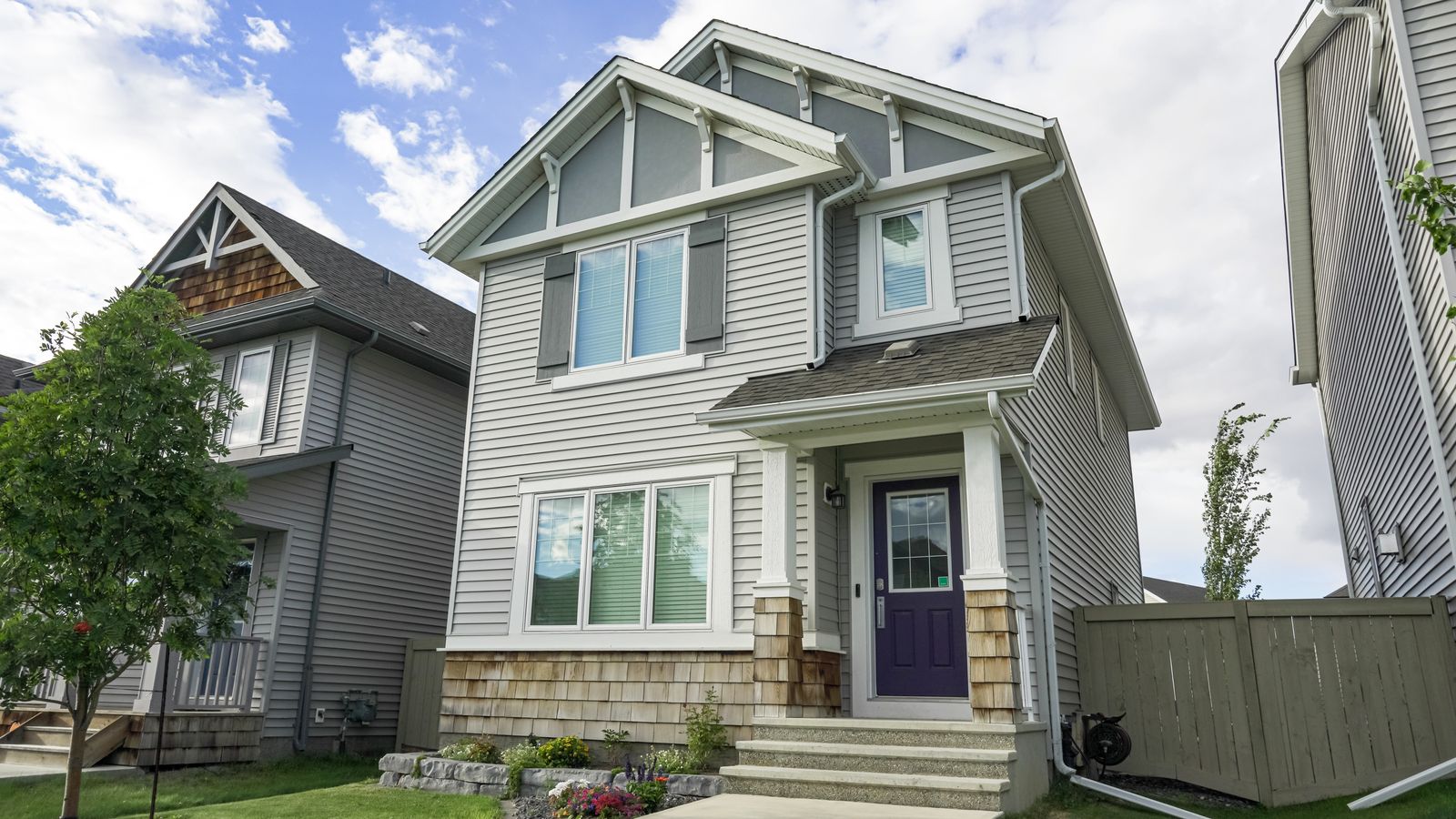
Illustrative photo, not a Bay Area property. Photo from Pexels.
Walk around your house and take a hard look at the siding. If it is cracked, faded, or curling at the edges, you have probably wondered what a full replacement costs, and whether any of that money comes back when you sell.
Here is the short answer. It comes from the 2021 national Cost vs. Value study, the study a real estate training course was built on. Fiber cement siding ranked number 4 of the 20 projects this guide covers, returning about 69 cents for every dollar spent. That is a strong showing for a big exterior job, and the picture around here has a few local twists worth knowing.
Prefer to watch? I walk through it on video in about seven minutes, including the three people who judge your siding before you close: the buyer, the inspector and the underwriter.
 Home Improvement Payback Guide VideoFiber Cement and the Three Gatekeepers7:08Play the walkthrough →
The job cost
$19,626
Back at resale
$13,618
The gap you absorb
$6,008
Cents back per dollar
69 cents
Numbers above are 2021 national averages from the Cost vs. Value study. They are a ranking guide, not a quote for your home.
What you spend, and what comes back at resale
The study priced one very specific siding job.
Before you compare your contractor's quote to any study number, know exactly what the study priced. Fiber cement is a board made from cement, sand, and wood fibers. It looks like painted wood but shrugs off fire, rot, and termites. The studied project was not a patch job. It covered:
- Replacing 1,250 square feet of existing siding with fiber cement siding
- New trim boards to finish the edges
- Boards that arrive factory primed and painted, so the color is baked in
If your bid covers more wall area or adds extras, your cost and your payback will both look different.
In 2021, the pricier siding actually won.
In the 2021 national Cost vs. Value study, this siding job cost $19,626 and brought back $13,618 when the home sold. That leaves a gap of $6,008, which works out to about 69 cents back for every dollar you spend. Keep in mind these are national averages, and Bay Area quotes usually run higher than these figures.
Now for the surprise. That same 2021 national study also priced vinyl siding, and the head to head result broke the usual pattern. Fiber cement cost more, $19,626 versus $16,576 for vinyl, and still returned a higher share of its cost, 69.4 percent against 68.3 percent. It was the one matchup in the study where the more expensive option came out ahead. Buyers, it turns out, can tell the difference from the curb.
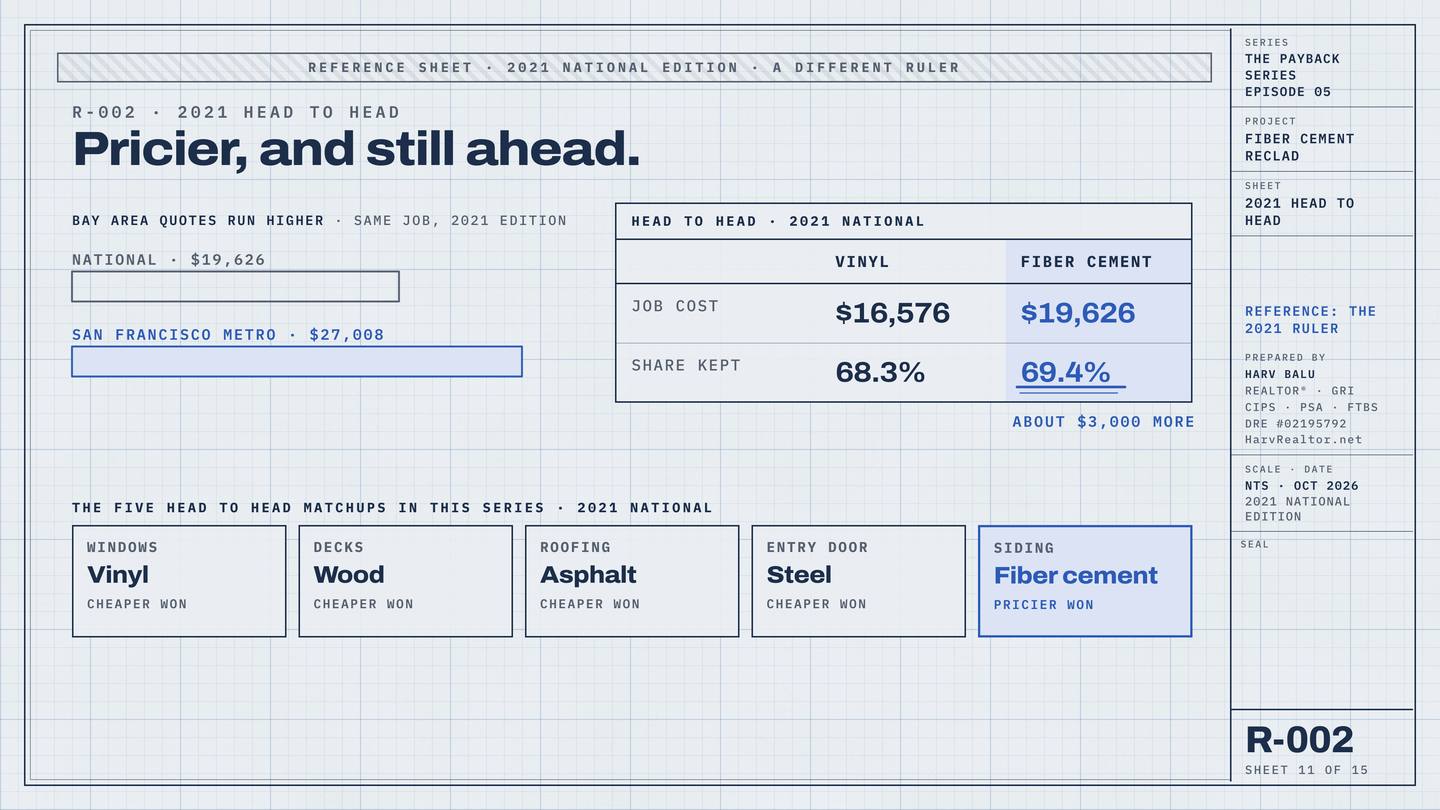
A plan sheet from my fiber cement video, 2021 national averages: vinyl siding cost 16,576 dollars and kept 68.3 percent of its cost at resale, fiber cement cost 19,626 dollars and kept 69.4 percent. Of the five head to head matchups in this series, siding is the only one the pricier option won. The sheet is drawn in code from the published averages, not a photo of a real home.
The 2025 metro numbers look even stronger.
Fast forward to the 2025 Cost vs. Value report for the San Francisco metro area, the report slice that includes Fremont, Newark and Union City. There, a fiber cement siding job cost $24,197 and returned $26,573 at resale. That is about 110 cents back for every dollar spent, meaning the average home in the report got back more than the job cost. One big caution before you get excited. The report changed how it measures costs and resale values between 2021 and 2025, so the two years cannot be compared. And these are averages from a study, not a quote for your house.
Around here, fiber cement solves a fire code problem.
Fiber cement is the siding answer that fits this area best. In mapped fire hazard zones, California's wildfire building rules set the standard for exterior walls. Those rules were Chapter 7A of the building code until January 1, 2026, and now live in the California Wildland-Urban Interface Code. Fiber cement is noncombustible, which is one of the ways a wall can comply. Vinyl generally needs a compliant wall assembly behind it, and cedar shake burns. If your home sits near open hills or a designated fire zone, those rules can make the choice for you.
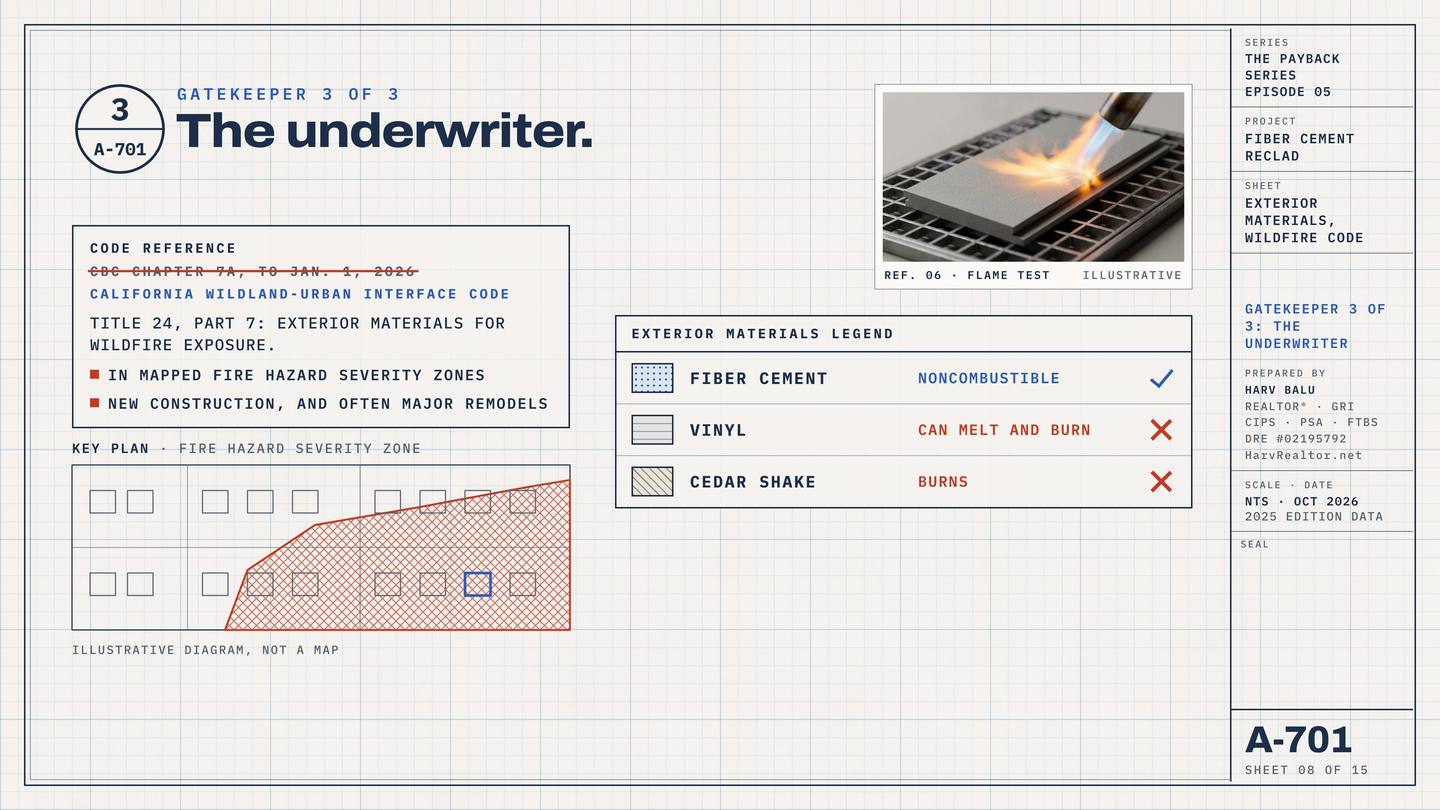
A plan sheet from my fiber cement video: the wildfire rules for exterior materials that were Chapter 7A of the building code until January 1, 2026 now live in the California Wildland-Urban Interface Code. Fiber cement is noncombustible; vinyl can melt and burn, and cedar shake burns. The zone drawing is illustrative, not a map. The sheet is drawn in code with a small AI reference image from Google NotebookLM.
One more local note. Most of the housing stock in the Tri-City area is stucco, not siding. A full siding replacement is simply less common here to begin with. If your home already wears stucco in good shape, this project probably is not on your list at all.
Selling soon? Paint first, unless the siding is failing.
A simple rule holds up well across all 20 projects: outside projects earn their keep when you sell soon, and inside projects are for the years you live there. New siding is squarely an outside project. Buyers see it from the street before they ever open the front door, and crisp new siding tells them the home has been cared for. If a sale is on the horizon and your current siding is rotting, cupping or failing, this project can work hard for you.
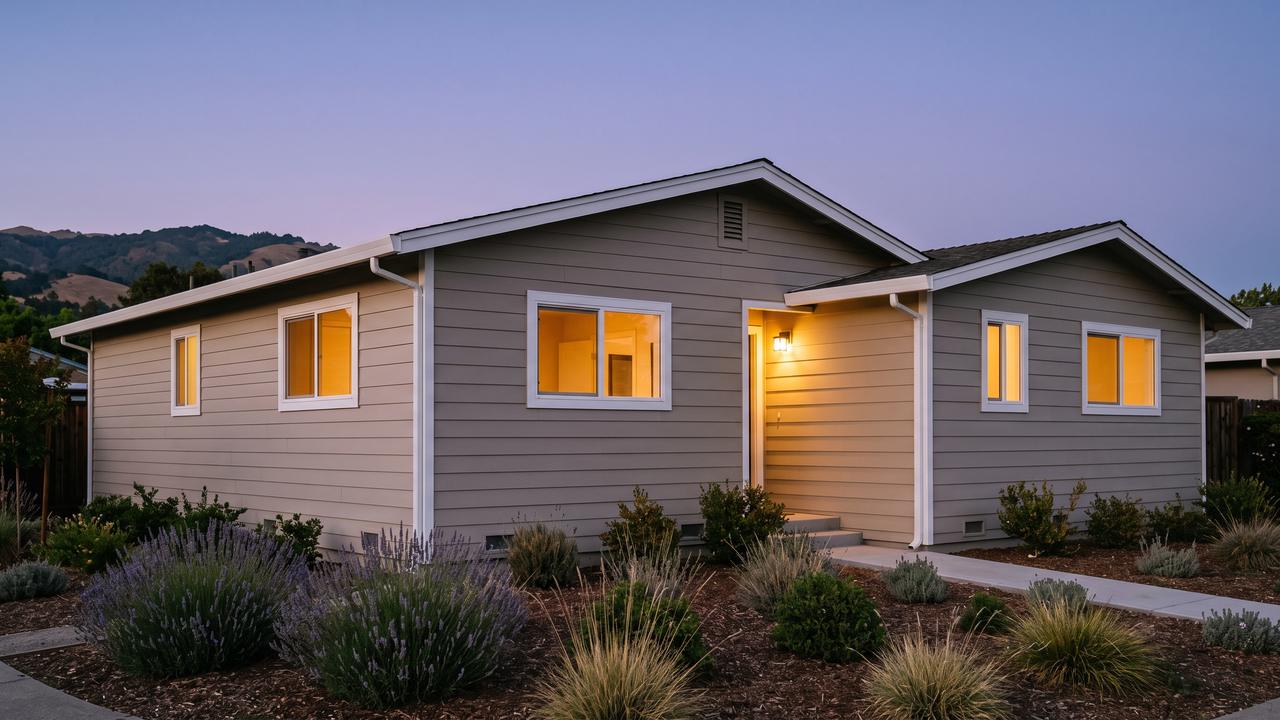
AI illustration from my fiber cement video: a ranch home after a fresh reclad, new lap siding and crisp white trim at dusk. A fifty year old house can photograph like a much newer one. The picture was generated with Google Gemini and does not show a real home or project.
Give yourself lead time, though. A siding job means finding the right contractor, waiting on materials, and living through some noisy weeks, so start the calls early. And here is the honest flip side. If your home is stucco in decent shape, or your existing siding just needs paint and a few repairs, skip the full replacement. Put that money where your house actually needs it.
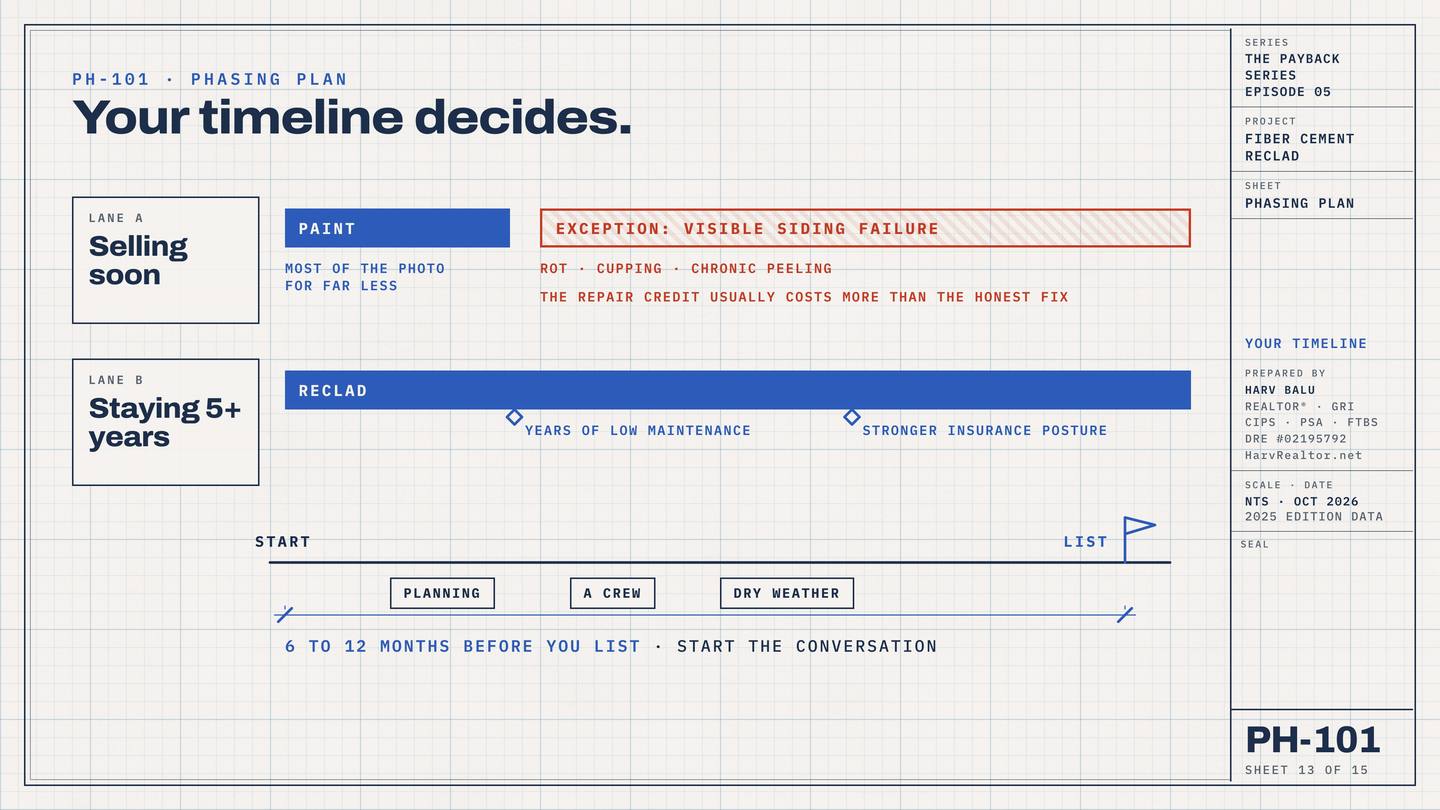
A plan sheet from my fiber cement video: selling soon, paint gets most of the listing photo for far less, unless the siding is visibly failing (rot, cupping, chronic peeling). Staying five or more years, a reclad buys years of low maintenance and a stronger insurance posture. Start the conversation 6 to 12 months before you list. The sheet is drawn in code, not a photo of a real home.
Questions homeowners ask
Does new fiber cement siding pay for itself when I sell?
Not fully, based on the older national data. In the 2021 national Cost vs. Value study, the job cost $19,626 and brought back $13,618 at resale, about 69 cents for every dollar spent. Those are national averages, and Bay Area quotes usually run higher. The 2025 Cost vs. Value report for the San Francisco metro area painted a stronger picture. But the report changed how it measures between 2021 and 2025, so the two years cannot be compared to each other.
Is fiber cement siding better than vinyl for resale value?
In the 2021 national Cost vs. Value study, yes, by a hair. Fiber cement cost $19,626 versus $16,576 for vinyl, and it still returned a higher share of its cost, 69.4 percent against 68.3 percent. It was the one matchup in that study where the more expensive option came out ahead. Both figures are national averages, and Bay Area quotes usually run higher.
My home is stucco. Should I switch to fiber cement siding before selling?
Probably not. Most homes in the Tri-City area are stucco, and buyers here expect it. If your stucco is in good shape, fresh paint and small repairs usually make more sense than a full siding job. Fiber cement matters most when a home already has siding that is failing. It also matters in a wildfire zone, where the state's wildfire building rules, Chapter 7A of the building code until January 1, 2026 and now the California Wildland-Urban Interface Code, limit what you are allowed to install.
More from this guide
- Every guide in one place: the Home Improvements page
- Start here: all twenty projects, ranked
- Part 3: The Small Kitchen Update That Beats a Full Remodel at Resale
- Part 5: Do Vinyl Replacement Windows Pay You Back When You Sell?
- Part 6: Why Vinyl Siding Is a Rare Choice in Fremont and the Tri-City Area
- Part 7: Wood Windows or Vinyl? What Bay Area Sellers Should Weigh First
See the full charts and payback calculator →
Thinking about selling in the next year or two?
The remodel conversation belongs 6 to 12 months before you list, while every option is still open. Start with what your home is worth today, then decide what, if anything, is worth doing.
Or just ask. Call or text Harv at 510 600 3425.
Cost and resale figures are from the Cost vs. Value Report, © Zonda Media, LLC (2021 national edition and 2025 San Francisco metro edition, costvsvalue.com), deemed reliable but not guaranteed. They are averages for the specific projects studied and are not an estimate or a prediction for any specific property. The 2021 and 2025 editions measure differently and are not comparable to each other. Prepared by Harv Balu, REALTOR®, GRI, CIPS, PSA, FTBS. REALTY EXPERTS®, DRE #02195792. Call or text 510 600 3425. Equal Housing Opportunity.